
The New York Times recently published a three-part video series about Russian disinformation operations. Many people have shared “Operation InfeKtion” with me, and I’ve been part of some discussions in some interesting venues. So I’m fascinated enough to share my reactions here.
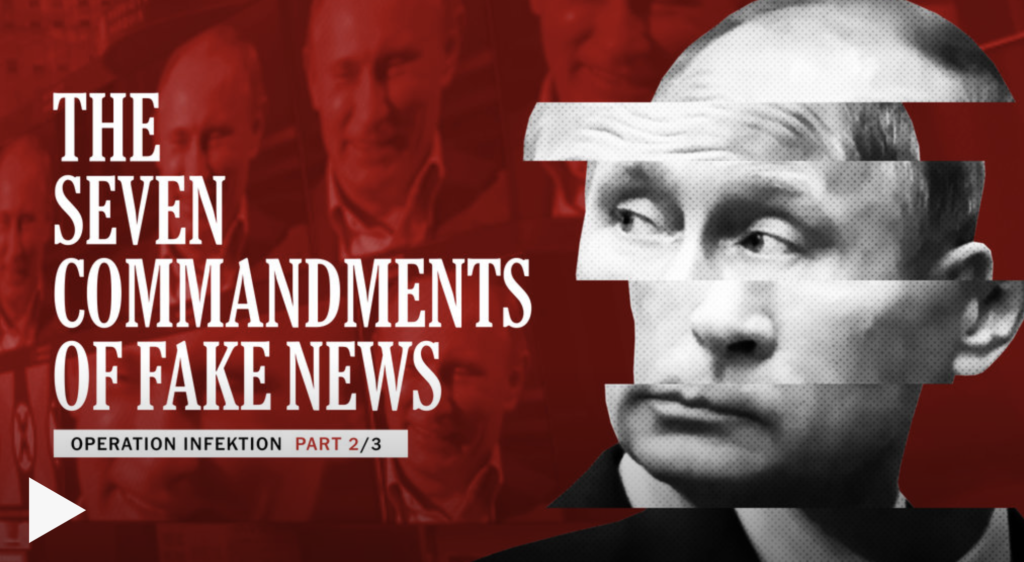
Overall, I’m ambivalent about the videos. I wonder about what the series tells us about our moment.
I appreciate “Operation InfeKtion”‘s research into the 1980s and the present. There are some very good uses of archival footage, especially from the Cold War. And bravo for tracking down old KGB agents in American retirement. (The title refers to a Soviet campaign to spread a story about the US supposedly creating AIDS. Here’s the Wikipedia page and also the CIA’s.)
Overall, the videos’ design is sharp. Visuals, audio, pacing, narration are pedagogically attuned to an audience likely to tune out. Many storytelling elements are in play: clear characters, multiple media streams to accentuate emotion, clarity about timelines, and certainly an anchoring problem. These are very compelling videos.
I also applaud the easy but all too necessary mockery of Congress for its deep digital ignorance. I can’t get enough of this, personally.
And yet… the videos are also weirdly shallow and disingenuous. They offer an important instance of emerging digital literacy views.
“Operation InfeKtion” openly calls for federal regulation of speech, straight up, without bothering to mention any policy or legal issues, like that pesky First Amendment or the contradiction of calling on a Trump-led government to take steps against the very foreign power the videos’ creators see as supporting him. I know much of Silicon Valley is in disrepute right now, but it was still surprising to see a leading newspaper publish content calling for censorship, industrial self-censorship, or other forms of content control without offering a shred of hedging or caveats.
In terms of non-federal or citizen action, there is no mention whatsoever of libraries and librarians. They just don’t play a role for the videos’ creators in terms of helping people grapple with information. Similarly, there’s just one glance at media literacy (not information literacy, not digital literacy) – and that was only to set it aside as not good enough, and without much argument. This is quite a view of how the creators assess individual, cooperative, and other forms of non-state information action. (It fits well into the authoritative, pro-neo-gatekeeper end of the digital literacy politics spectrum I outlined nearly two years ago.)
Back to the historical aspect of the videos: the look at Cold War information operations is precisely Reaganesque. Reagan is the story’s hero, appearing to save the day, and his policies appear as good ones. Indeed, the videos are flat-out pro-Reagan without any hint of criticism of that famously controversial president (is this really from the NYTimes?
). Meanwhile, there’s no mention of the US pumping out information operations for decades, nor of the many other reasons the US-caused-AIDS story would have been credible to many people (i.e., the long history of the CIA’s global capers, the nearly century-long US creation of biological and chemical weapons, etc). I’m not saying this to support the US-caused-AIDS story. And I don’t want to fall into a debate on “whataboutism“, but instead to point out that disinformation works by working with preexisting materials and conditions, not by inventing things whole cloth. These stories work because they draw on beliefs and attitudes already in play, and not always for goofy or fantasy-based reasons. They pick on established tensions and irritate them.
As one Daily Kos commentator puts it,
Of course it’s not hard for African Americans to believe in the possibility of this being true given the Tuskeegee experiments, Henrietta Lacks, COINTELPRO, Jim Crow, slavery … Hell, there isn’t much I wouldn’t believe about this government mistreating African Americans.
To their credit, the videos eventually note this, if only once, but don’t develop the point.
(Plus there’s a weird slip between asserting KGB agents had to devote 25% of their time to proposing disinfo to, a few minutes later, saying they spent 25% carrying out such operations. Anyone who’s worked with a bureaucracy, or who knows anything about the Soviet one, knows the huge difference between brainstorming and work.)
As media criticism, the videos also let tv news almost completely off the hook*. In their view tv news looks simply heroic, overall, like Ronald Reagan. “Operation Infektion” begins with a mention of Dan Rather spreading fake news, then invites our sympathy for him without explaining how he came to share KGB-created ideas. Later on the videos celebrate European anti-disinfo tv news for working to stop modern Russia. Only at the end – and without the verbal narration, oddly – do we get a few visual flashes of Fox News. In contrast, the steep decline of American tv news into Fox and Headline News does not appear. Ultimately this view of tv news is shallow or cartoonish, constituting a serious blind spot in the videos’ argument. It begs critical questions. Why and how does tv news relay disinformation? What does it take for a tv news operation to boldly resist Moscow’s transmissions, and for what reasons do they not do this? Since American tv news is often so bad at actually doing journalism, how can we trust them to fight disinfo?
The videos also don’t make a case for the scale of disinfo’s impact. They show some individual stories, like Pizzagate, but never cite stats about, say, how many people actually read Russian-generated Facebook ads, or how many Twitter bots came from the Kremlin. (There’s a brief gesture against this, actually, when the videos show tech company representatives giving stats about the # of accounts, while the narrator charges them with being wrong) Since the idea is to scare the heck out of the audience, alerting us to a major threat, the producers would have done well to show us just how big the danger actually is.
As you might deduce by this point, “Operation Infektion” is not so much analytical as passionate, even propagandistic. Listen to the scary music that occurs fairly often in all three parts, even including horror-film-style creepy chanting. Check out not only the language of infection and invasion, but also the repeated images of viruses and blood:

“Operation Infektion” is clearly advocacy journalism, despite the Times’ calm introductory paragraphs (but acknowledged in the host page’s URL, which places it in opinion). We are not meant to be analytical but terrified, and then to support taking steps against the menace. In fact, at the end of the second video comes this flat out charge, echoing Morgan Freeman: “We’re at war.” This blithely summons us to a war mentality (and, presumably, a war footing, although policy recommendations are scant) without a shred of discussion about, say, how cyberwar works in the 21st century, or the geopolitical framework involved, much less the challenges of warfare between history’s two greatest nuclear powers. This is enormously complex stuff; surely the videos could have gestured to this, if they determined that they couldn’t dive into the topic.
Overall, I’m still curious about what what “Operation Infektion” means as a datapoint from 2018, looking forward. It certainly represents a strong call for the authoritative/neogatekeeper side of the information/digital/media literacy world. Allied to that is the call for some form of censorship or content control; I expect to hear more of this. It also offers another example of people doing media criticism without criticism tv news.
As an intervention into the Russia story, it represents a strong, even panicked call to arms. As such it falls into the long American tradition of civilians lobbying citizens and the government for stronger or simply military responses to perceived geopolitical threats. I am curious how this will change now that Democrats have partial control over one branch of the federal government. Will the House pass bills somewhere in this area, even against the likelihood of Senate failure?
“Operation Infektion” also fits into the emerging sense of strong continuity between the USSR and Putin’s Russia, despite their many, sometimes radical differences.
As storytelling, these videos offer a good example of very finely crafted, very intensely packed digital stories. As a persuasive story “Operation Infektion” looks like a modern classic of the form, although I’d like to pair it with a digital story making a more quantitative case.
*I have been waging a very unpopular campaign against American cable news for a while. Here are some examples.